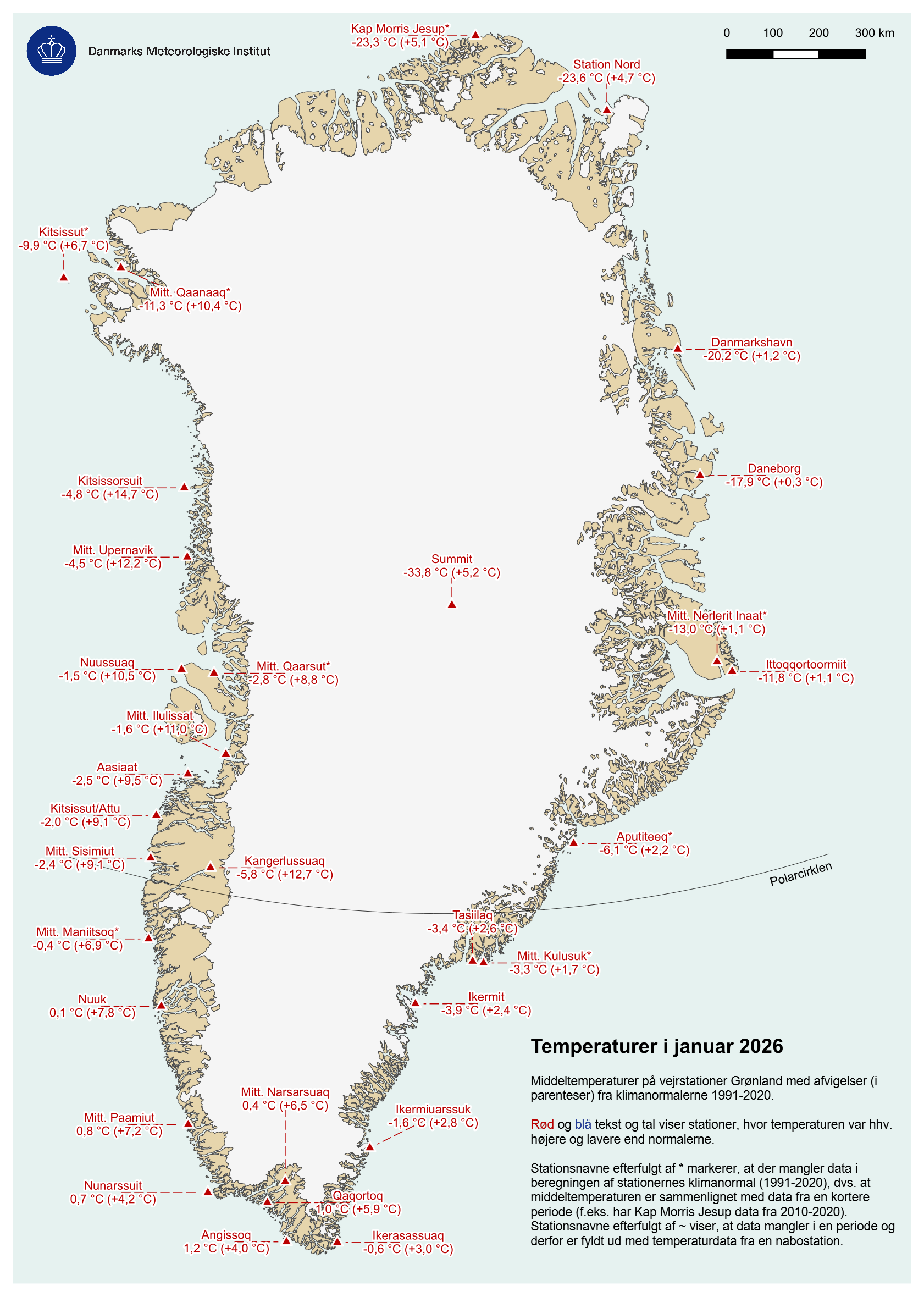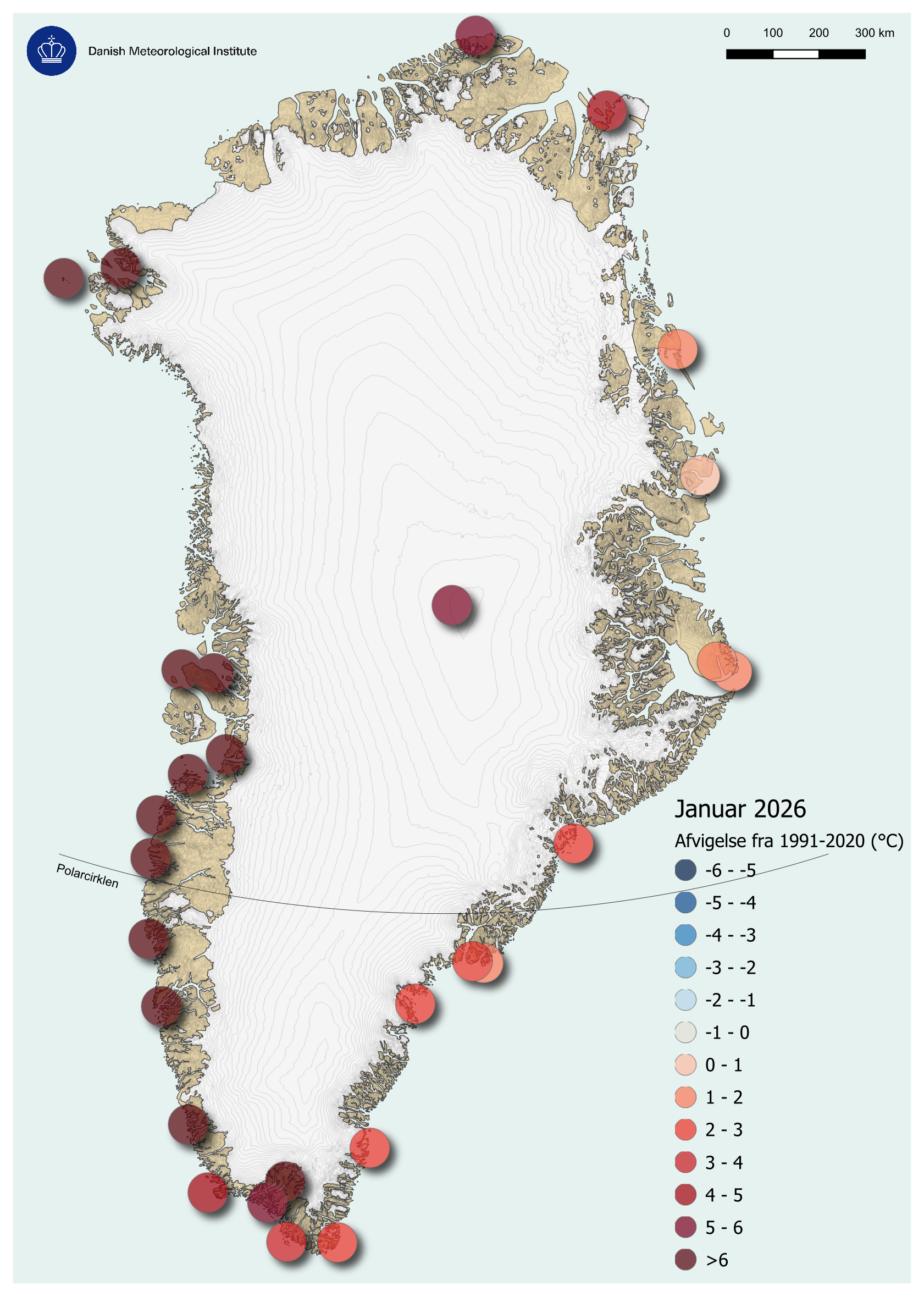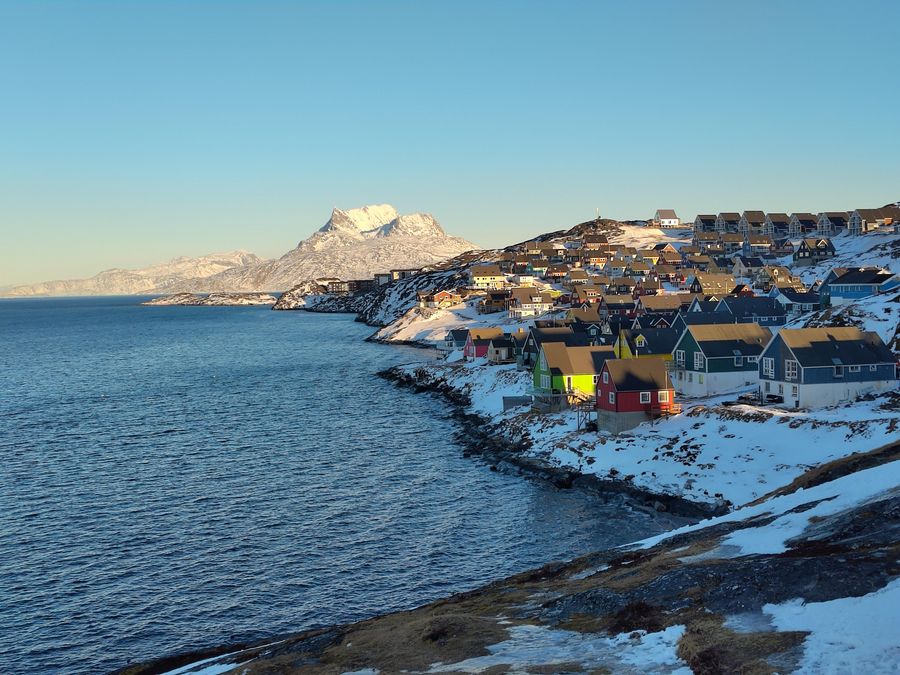
While the cold has taken hold in Denmark, warm air has flowed up to Greenland on several occasions, sending the thermometer into the red in several places. Snow and frost have melted away as if it were spring, and residents have been walking around with their jackets open.
The warmest day in January in Nuuk saw temperatures rise to 11.3 degrees, and the average for the entire month was 0.1 degrees.
0.1 degrees is a new record for Nuuk in January. The record is 7.8 degrees above the climate norm (1991-2020) and 1.4 degrees above the 109-year-old record for Nuuk from 1917.
But it wasn’t just in Nuuk that temperatures deviated from the norm. From the southern tip of Greenland and all the way up along the west coast – a stretch of over 2,000 km – temperatures set monthly records.
For example, in Ilulissat on Disko Bay, the January monthly average also reached a new level.
The average for January was 1.6 degrees below freezing. This is 1.3 degrees warmer than the previous record from 1929 and 11.0 degrees warmer than normal for January.
– The heat has affected the entire western part of Greenland, and several towns are experiencing exceptionally warm weather for this time of year. From time to time, warmer air flows over Greenland, or foehn winds can bring above-zero temperatures for a day or two. But such significant deviations, over such a long period and over such a large area, are something that makes an impression, says DMI climatologist Caroline Drost Jensen, adding:
“I am keeping a close eye on the temperature measurements in February, as the winter in Greenland may well end up setting several records.
Read about how the heat in Greenland is linked to the cold in Denmark
Climate change challenges the frost
From time to time, the cold and the heat switch places, and occasionally the thermometer creeps above zero degrees in winter in Greenland. The heat record does not come as a surprise to Martin Olesen, a climate researcher at the National Centre for Climate Research at DMI.
“When we see a heat record for an entire month in a 150-year measurement series, it could of course be a coincidence, but when you see records at the same end of the temperature scale clustered together at the end of a long measurement period, as in Nuuk and several other towns in Greenland, it is a clear indication that something is changing. And something is changing, says the climate researcher, continuing:
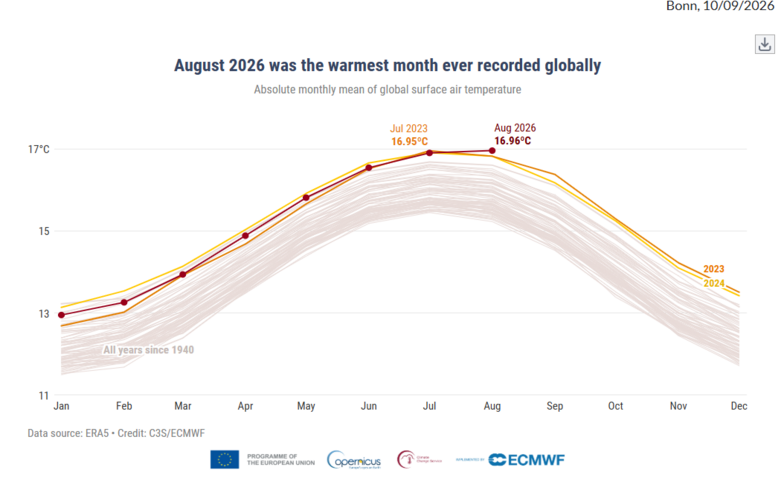
“We both know and can clearly see that global warming is in full swing, which, as expected, is resulting in more records at the warm end of the temperature scale and gradually fewer records at the low end of the temperature scale.
The current situation, where it is warm in Nuuk and Southwest Greenland and cold in Denmark, is a well-known weather phenomenon. But according to Martin Olesen, the somewhat unusual warm weather in Nuuk is probably being given an extra boost by global warming and the fact that the Arctic is generally warming 3 to 4 times faster than the global average.